Introduction to Fraction
A fraction represents a part of a whole or more simply, any number of equal parts. In arithmetic, it is explained as a number expressed as a quotient, in which a numerator is divisible by a denominator. Fractions are represented like this 4/9, 1/3, or 13/15. In a simple fraction, both numerator and denominator are integers. A complex fraction means one or both terms are fractional numbers. In a proper fraction, the numerator is less than the denominator. Taking assistance from the professionals of BookMyEssay and Vulgar and Decimal Fractions assignment help will not only guide the students to understand the subject matter but also help them to solve for academic writing problems on decimal and vulgar fractions.
A Brief Overview on Vulgar and Decimal Fractions
In arithmetic, a fraction is treated as a ratio, where the two numbers are related to each other to show a part of the whole relationship. When the numerator is divided by the denominator, we get a fraction. For example, 3/4 is 3 divided by 4 which can also be shown as decimal 0.75 or 75 percent. This fraction represents the 3 equal parts of the whole object when it is divided into 4 equal parts. Every fraction has two parts a numerator and a denominator. The fraction that has both the numerator and denominator the same, means it is 1 but this form is not given at the result since it is impossible to divide anything into equal parts.
A vulgar fraction is also termed a common fraction. A vulgar or common fraction has both the numerator and denominator integers. Denominators of this kind of fractions are not 10,100 or 1000. For example 1/5, 7/15, etc.
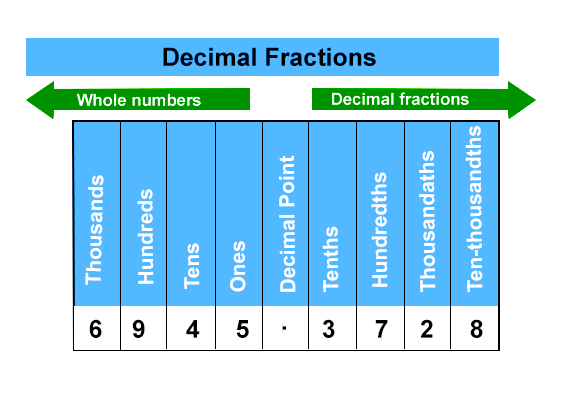
Decimal fractions are those having denominators 10, 100, 1000, etc. For example 3/10, 11/1000, etc.
 Australia
  UK
UK World
World





 3 Bellbridge Dr, Hoppers Crossing, Melbourne VIC 3029