They allow trusted agreements and transactions to be done among anonymous and disparate parties without the requirement of any central authority, external enforcement mechanism or legal aspect. Though blockchain technology is primarily thought of as a foundation for bitcoin, this has evolved much beyond virtual currency.
What Are The Advantages of Smart Contracts?
The advantages are discussed in our SmartContracts Assignment Help as follows:
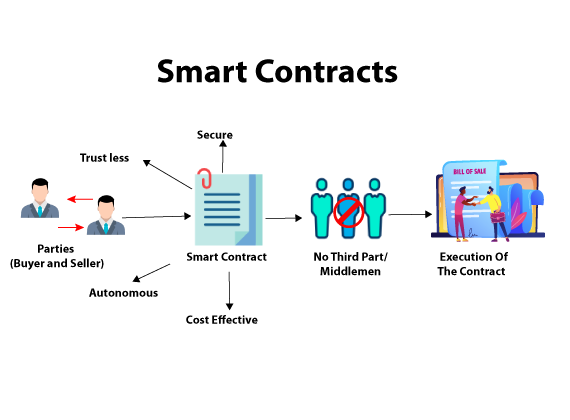
Efficiency, Speed & Accuracy: If a condition is met, a contract gets executed immediately. As smart contracts are automated and digital, there is no paperwork and no time is spent to reconcile errors that come from filing documents manually.
Transparency & Trust: As there is no involvement of a third party and as encrypted transaction records are shared with participants, no question arises regarding whether information has been changed for personal gain.
Security: Blockchain records are encrypted which makes it different to hack. As every record is connected to an earlier and subsequent record on ledgers, hackers need to change the complete chain for changing one record.
Savings: Smart contracts do not need intermediaries for handling transactions and this way they reduce time delays. This results in savings.
Applications of Smart Contracts
Smart Contracts are used in multiple industries and they are highlighted in our SmartContracts Assignment Help as follows:
- Dispute Resolution: Financial analysis discrepancies are expensive and they take weeks and months to resolve and research. Smart Contracts codify business rules and automate processes including reconciling documents, identifying discrepancies, resolving disputes, and settling transactions.
- Banks: Using Smart contracts and blockchain, many banks have transformed and digitized the process of bank guarantees for performance as well as financial guarantees. There is a new platform known as Lygon that allows issuers, applicants, and beneficiaries to get a legally binding guarantee in a day.
- Trade Finance: Smart Contracts are a component of trade finance. Simplified trading options and standardized rules encoded in these contracts reduce risk and can help participants look for new opportunities.
- Supply chain: Supply chains management uses smart contracts for streamlining the flow of goods by triggering the subsequent steps if conditions are met including shipping, IoT data, and delivery. Participants can act previously and prevent any kind of disruption when there is an unexpected event.
Organizations that use smart contracts provide web interfaces, templates, and online tools for simplifying the structure of smart contracts.
 Australia
  UK
UK World
World





 3 Bellbridge Dr, Hoppers Crossing, Melbourne VIC 3029